
Something quiet but irreversible is happening inside the warehouses, Instagram DMs, and WhatsApp Business accounts of India's small businesses. A kirana-turned-brand owner in Jaipur who started selling handmade leather wallets on a marketplace three years ago now runs her own website, ships to forty cities, and earns 22 percent more per order — because she cut out the platform's commission entirely. A skincare founder from Coimbatore who built his customer base through Instagram Reels has never listed on Flipkart, and has no plans to. A home-décor collective from Kutch processes orders through WhatsApp Commerce and a lightweight website, operating with a team of five.
These are not outliers. They are the early adopters of what McKinsey & Company, in a landmark February 2026 report, called "the great unbundling of Indian e-commerce." The era of every small seller depending on the giant marketplace as their only path to the customer is ending. In its place: a fragmented, flexible, direct-to-consumer ecosystem that is growing faster than almost anything else in Indian retail.
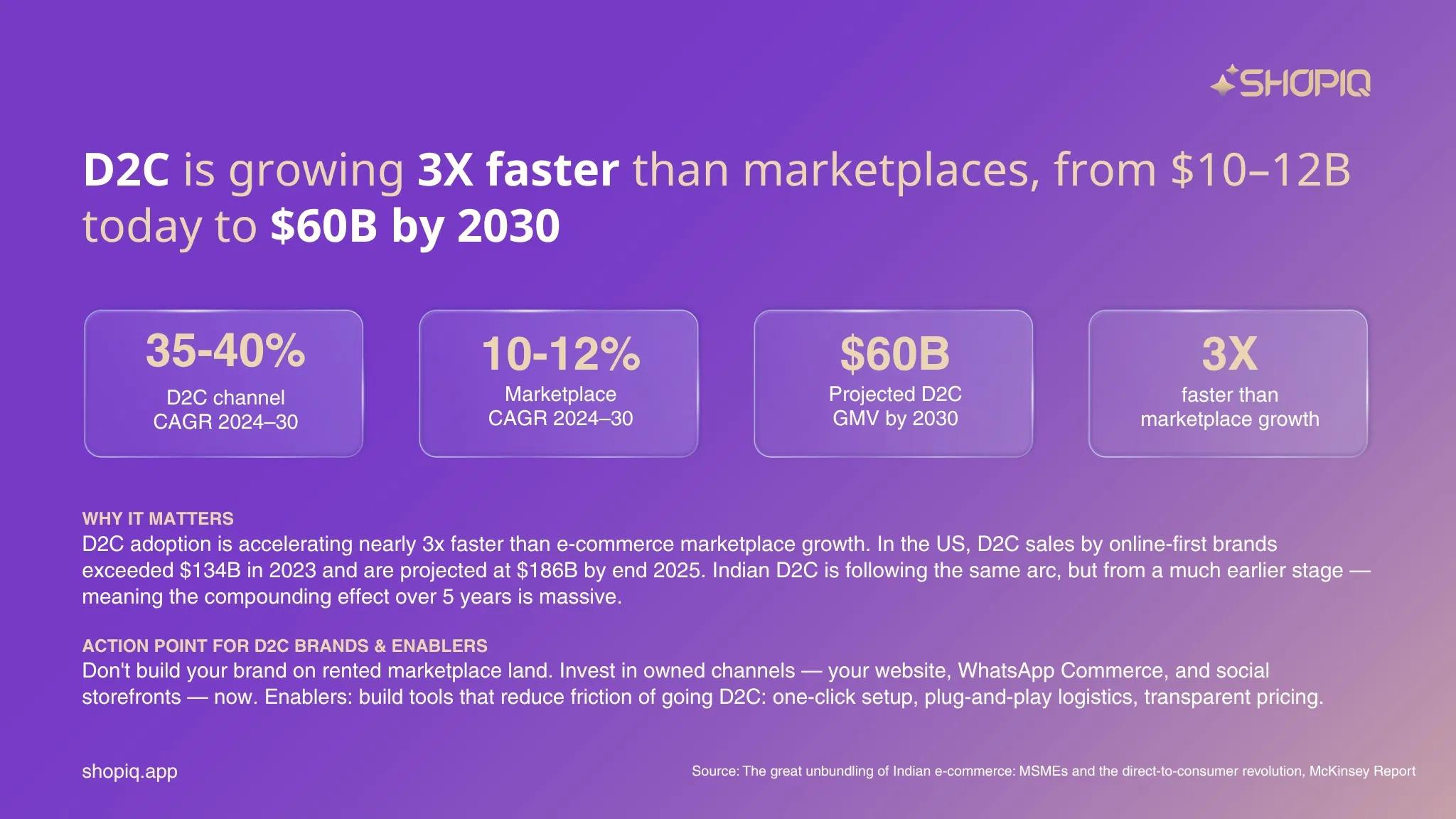
The numbers are striking. India's D2C channel — encompassing brand websites, social storefronts, WhatsApp Commerce, and app-based direct sales — currently accounts for roughly $10–12 billion in e-commerce GMV. By 2030, McKinsey projects that figure will reach $55–60 billion. That is a compound annual growth rate of 35–40 percent — nearly three times the 10–12 percent CAGR projected for traditional marketplace platforms over the same period.
"Digital tools and platforms are no longer optional for Indian small businesses. They are the bridge to customers across continents, democratising market access in ways unimaginable a decade ago." — Shri Jitan Ram Manjhi, Union Cabinet Minister for MSME, Government of India
This article is not a cheerleader piece. It is an attempt to understand, with clear eyes and real data, why this shift is happening, what is driving it from both the demand and supply sides, and — critically — what it means for the millions of Indian small businesses that are still deciding whether to stake their future on rented marketplace land or build something they actually own.
The Structural Reality: 60 Million MSMEs, One Fragmented Market
Any honest analysis of D2C growth in India has to begin with a fact that shapes everything else: India's retail landscape is not just large, it is structurally fragmented in a way that no other major economy quite matches. Nearly 60 million micro, small, and medium enterprises form the backbone of India's commercial ecosystem, collectively contributing close to $1 trillion in annual economic value — approximately 30 percent of national GDP.
These businesses do not all look alike. They span handloom weavers in Varanasi, ayurvedic skincare makers in Kerala, electronics assemblers in Pune, and food processing units in Punjab. They exist across formal and informal economies, across categories, geographies, and scales. And crucially — nearly 50 percent of India's registered small enterprises are located not in metros, but in Tier-2 and Tier-3 cities.
Key numbers at a glance:
- 60 million MSMEs in India
- ~30% share of national GDP
- ~50% of MSMEs located in Tier-2 / Tier-3 cities
- 6–8% current e-commerce penetration (vs. 23–25% in the US, 25–27% in China)
For decades, this fragmentation was considered a constraint. Small brands had limited distribution reach. Physical retail required capital-intensive supply chains. The rise of e-commerce marketplaces in the 2010s seemed to solve this — suddenly, a Rajasthan artisan could list products and reach buyers in Bengaluru. But as the decade wore on, a more uncomfortable reality set in: the marketplace model came with its own set of constraints that often made it unsuitable for smaller, independent brands.
High commission rates — often ranging from 15 to 40 percent depending on the category and the platform — ate directly into already thin margins. Brand visibility was algorithmically controlled: those who paid more for advertising slots rose in search results; those who could not were effectively invisible. Customer data remained locked inside the platform. And perhaps most critically, brands had no durable relationship with the person who bought their product. The customer belonged to the marketplace, not to the brand.
This is why, when McKinsey surveyed over 1,000 Indian MSMEs in November 2025, they found something revealing: 53 percent of these businesses now prefer D2C routes over marketplace sales. The shift is not marginal. It is a structural transition driven by MSMEs seeking more flexible, direct, and lower-cost pathways to reach consumers.
Why Marketplaces Remain Essential (But Are No Longer Sufficient)
It is important to state this clearly: the death of the marketplace is not what is happening. Amazon India, Flipkart, Meesho, and Myntra are projected to reach $90–100 billion in GMV by 2030. Their scale, logistics infrastructure, and discovery engines make them foundational to India's digital retail ecosystem, particularly for products where price comparison and breadth of selection drive the purchase decision.
What is changing is the calculus for brands. Marketplaces are increasingly understood to be customer acquisition channels — powerful, expensive, and appropriate for certain types of products — rather than the totality of a brand's commerce strategy. The brands that are winning in India today are the ones using marketplaces for discovery while using their own channels for retention, loyalty, and profitability.
E-commerce by channel — 2024 vs. 2030 (McKinsey projections):
Channel2024 GMV2030 ProjectionCAGRE-commerce Marketplaces$55–60B$90–100B~10–12%Direct-to-Consumer (D2C)$10–12B$55–60B~35–40%Quick Commerce$5–6B$35–40B~45%Overall E-commerce~$70–80B$180–200B~20%
Source: McKinsey & Company, "The Great Unbundling of Indian E-Commerce," February 2026
The McKinsey research found five primary reasons why MSMEs prefer direct sales, ranked by survey respondents: lower platform fees, lower fulfillment costs, better access to first-party customer data, better overall consumer experience, and greater control over brand identity and messaging. The first two are economic arguments; the latter three are strategic ones. Together, they reveal that the D2C preference is not just about saving money — it is about building something durable.
The Tier-2 and Tier-3 Revolution Nobody Is Talking About Loudly Enough
The received wisdom for years was that digital commerce in India was primarily a metro phenomenon — Mumbai, Delhi, Bengaluru, Hyderabad, and Chennai driving the lion's share of GMV while smaller cities lagged behind. That picture is now significantly outdated.
Tier-2 and Tier-3 cities currently contribute more than 60 percent of total e-commerce shipments in India. Roughly half of India's registered small enterprises are located in these cities. Their GST collection growth now mirrors that of Tier-1 cities — a data point that would have seemed implausible a decade ago, and one that speaks to the accelerating economic formalisation of these regions.
Several structural forces are converging to drive this. The Digital India initiative has brought high-speed internet to over 95 percent of India's towns and villages. The Pradhan Mantri Jan Dhan Yojana has enabled over 550 million bank accounts in rural and semi-urban areas. The Reserve Bank of India's Payments Infrastructure Development Fund has deployed over 45 million digital touchpoints. And UPI — in August 2025 alone — facilitated 20 billion transactions processing over ₹24,85,000 crore in value, a 34 percent year-on-year volume increase.
"Consumers in Tier-2 and Tier-3 cities have become more discerning. Many are willing to pay online for specific products rather than settle for what's available in local stores or big platforms." — Head of E-Commerce, Leading Indian Fashion Retailer
By 2030, over 140 million more Indian households are projected to cross the $10,000 annual income threshold. Most of these newly affluent consumers will not be located in metros — they will be in Jaipur, Indore, Lucknow, Coimbatore, Kochi, Bhubaneswar. They will be online. They will be demanding. And they will be looking for brands that speak to them in their language, understand their cultural context, and can deliver to their pin code reliably.
This is the real opportunity for D2C brands — and it is one that a generic marketplace listing, built for a national lowest-common-denominator experience, often cannot adequately serve. A brand-owned website or WhatsApp storefront can run a Diwali campaign in Hindi, a Pongal offer in Tamil, an Eid collection in Urdu, and adjust its logistics partner based on the customer's region. That level of contextual commerce is genuinely difficult to achieve through a marketplace interface.
Social Commerce: The Discovery Layer That Changes Everything
One of the most consequential findings in the McKinsey MSME research is about how consumers discover small businesses online. Instagram and Facebook ads ranked first — with an index score of 100 out of 100 in the survey. Influencers and content creators ranked second at 81. Google Search came third at 71. Word of mouth and referrals sat at 68. E-commerce marketplace discovery scored only 50. WhatsApp scored 42.
How consumers discover small businesses online (McKinsey Consumer Survey, Nov 2025):
- Instagram / Facebook ads — 100
- Influencers / Content creators — 81
- Google Search — 71
- Word of mouth / Referral — 68
- E-commerce marketplaces — 50
- WhatsApp — 42
This matters enormously for how brands should think about their online presence. The purchase journey has fundamentally changed. The traditional e-commerce model was linear: a consumer searched for a product, compared options, evaluated, and bought. The social commerce journey is different: a product appears organically in a feed, an influencer creates context and desire, peer validation through comments and shares builds trust, and then an in-app checkout or a quick redirect to a brand website completes the purchase.
Indian brands like Mamaearth, boAt, Sugar Cosmetics, Lenskart, and Nua built enormous consumer businesses by understanding this shift early. They did not wait for marketplace discovery algorithms to surface them. They went directly to where their customers spent their time — Instagram, YouTube, regional language platforms — built communities, told stories, and then converted that attention into sales through owned channels.
The MSME survey showed that 54 percent of Indian small businesses already prefer social media as their primary mode of customer interaction — ahead of marketplaces at 32 percent, websites at 8 percent, and quick commerce at 7 percent. What this tells us is that Indian MSMEs are not unaware of these shifts. Many are already living them. What they often lack is the infrastructure to convert social discovery into reliable, scalable D2C sales.
The Pain Points That Keep Small Brands Stuck
Understanding the D2C opportunity requires equal understanding of why so many small brands have not fully made the transition. The barriers are real.
The working capital gap. Many MSMEs operate with constrained working capital. Credit access is limited, and when cash is tight, paying upfront for inventory before receiving marketplace payment cycles creates genuine stress. The D2C model, while better for margins long-term, requires upfront investment in infrastructure — website setup, payment gateway integration, shipping partnerships, and marketing spend — that marketplace listings do not immediately demand. This front-loaded cost structure deters many early-stage brands.
The discovery problem. Marketplaces provide built-in traffic. A brand-owned website does not. Building organic traffic through SEO, paid social, influencer partnerships, and content takes time, skill, and sustained investment. Many MSME founders are product experts, not digital marketers. The gap between having a beautiful website and actually driving meaningful traffic to it is one of the most common failure points in the D2C journey.
Checkout abandonment. D2C brands lose significant revenue at checkout. Cart abandonment rates in India's e-commerce context are high — driven by friction in the checkout flow, limited payment options, poor mobile optimisation, and lack of trust signals like buyer protection or merchant verification. On a brand-owned website, trust must be earned independently. That takes deliberate design choices and the right payment infrastructure.
Fulfillment and logistics. Marketplaces bundle logistics. An MSME selling on Flipkart or Amazon can use their fulfillment networks and track-and-trace systems. A D2C brand must either build its own logistics relationships or use third-party fulfillment providers. In Tier-2 and Tier-3 cities, last-mile delivery reliability remains variable. High cash-on-delivery return rates — running at 25–30 percent for some categories — create working capital cycles that can be destabilising for small brands.
The $25–30 Billion Enabler Market McKinsey estimates the total addressable market for modular, unbundled digital commerce services tailored to Indian MSMEs at $25–30 billion by 2030 — representing roughly 50% of the projected D2C channel size. The gap is not in the willingness of small brands to go D2C. It is in the tooling, infrastructure, and support systems they need to do it successfully.
What the Unbundling Actually Means in Practice
The McKinsey report's central thesis is captured in its title: the "unbundling" of Indian e-commerce. Traditional marketplaces are bundled solutions. When a seller lists on Amazon or Flipkart, they get discovery, checkout, payments, logistics, customer service, and returns management as a single package. This is convenient — but it is also inflexible. Sellers pay for everything whether they need it or not. They cannot substitute a cheaper logistics partner. They cannot implement their own loyalty programme. They cannot access their customers' contact information to build a direct relationship.
The D2C model is an unbundled one. A brand-owned website handles the storefront. A payment gateway handles checkout. A third-party logistics provider handles shipping. A CRM tool manages customer relationships. Marketing automation tools handle retention. The brand chooses and combines these services like building blocks — paying only for what it needs, switching providers when better options emerge, and retaining full control over data and customer relationships at every point.
This modular architecture is more complex to set up, but it produces dramatically better economics at scale. A brand selling ₹10 lakh per month through a marketplace at 25 percent commission is paying ₹2.5 lakh per month in platform fees alone. A brand running the same revenue through an owned website with a well-configured payment gateway and logistics partnerships might pay 5–8 percent in combined transaction and delivery costs — a potential saving of ₹1.7–2 lakh per month that goes directly to the bottom line or gets reinvested in customer acquisition.
The government's Open Network for Digital Commerce (ONDC) is another important piece of this picture. By unbundling the traditional marketplace model into interoperable microservices — separating buyer-side apps, seller-side apps, logistics providers, and payment networks — ONDC is creating infrastructure rails that could dramatically lower the cost and complexity of going D2C for small businesses. Through ONDC, McKinsey estimates the value of digital commerce could rise fivefold to $320–340 billion by 2030.
The AI Layer: From Tools to Intelligence
The next frontier for Indian D2C is not just better websites and cheaper logistics — it is intelligence. EY India estimated in 2025 that generative AI could enhance productivity across India's retail industry by 35–37 percent by 2030. The practical applications are already visible: AI-powered product recommendations that adapt to individual browsing behaviour, dynamic pricing tools that respond to demand signals, automated customer service that handles returns and queries in regional languages, and demand forecasting that reduces inventory waste.
For small brands, the democratisation of AI tools changes the competitive calculus meaningfully. The personalisation that large marketplace platforms achieve through scale and data can now be approximated — at a fraction of the cost — through AI-powered D2C platforms. A brand-owned website equipped with the right intelligence layer can deliver a shopping experience that is as contextually relevant as anything a major platform offers, but with the brand's own voice, values, and relationship with the customer at its centre.
"The future of competitive advantage might well hinge on creating an expansive single source of truth, where multidimensional data is seamlessly integrated and analysed with AI." — McKinsey & Company, "The Great Unbundling of Indian E-Commerce," February 2026
This is not a distant aspiration. Brands that are investing now in first-party data — building email lists, capturing WhatsApp opt-ins, logging purchase histories on their own platforms — are accumulating an asset that will compound in value as AI tooling improves. Every customer who buys through a brand's own website is a data point the brand owns. Every customer who buys through a marketplace is a data point the marketplace owns.
What Successful D2C Infrastructure Actually Requires
McKinsey's conversations with Indian MSMEs and industry experts identified eight focus areas that matter most for brands trying to build a successful D2C business:
1. Flexible, affordable solutions with usage-linked pricing rather than large upfront commitments. Small brands cannot absorb fixed infrastructure costs when they are still at uncertain revenue scales.
2. Intuitive, easy-to-adopt tools that do not require technical expertise to set up or maintain. Most MSME founders are product experts, not software engineers.
3. A comprehensive product suite spanning the entire sales lifecycle — from sourcing through checkout to post-purchase loyalty — so founders are not stitching together ten different tools from ten different vendors.
4. Seamless omnichannel integration that unifies online and offline operations with real-time dashboards for inventory, sales, and customer data.
5. Robust technology infrastructure with AI capabilities like demand forecasting, risk scoring, and personalisation built into the platform.
6. Strong data privacy and security compliance so that customer data is handled in a trustworthy, regulation-compliant way.
7. Strategic partner ecosystems that give brands access to a range of logistics and payment options at competitive price points.
8. Continuous innovation — platforms that evolve with the needs of the brands they serve, not ones that stay static while the market moves around them.
What is striking about this list is how clearly it describes a vision of commerce infrastructure that is radically different from the bundled, take-it-or-leave-it offering of the traditional marketplace. Indian MSMEs do not want to be passengers on someone else's platform. They want to be captains of their own commerce operations, with the tools to compete effectively on their own terms.
Looking to 2030: The Brands That Will Win
If the McKinsey projections hold — and the structural drivers behind them are robust — India's D2C market will be a $55–60 billion channel by the end of this decade. The brands that will have the largest share of that market are, with high probability, the ones making decisions today about how to build their owned commerce infrastructure.
The brands that will struggle are the ones that continued to treat their marketplace presence as their only digital strategy — waking up in 2028 or 2029 to find that their competitors have built email lists of 500,000 loyal buyers, have data on every purchase decision their customers have ever made, and have unit economics that allow them to profitably acquire and retain customers at a cost the marketplace-dependent brand simply cannot match.
India's e-commerce penetration currently sits at 6–8 percent of total retail — compared to 23–25 percent in the United States and 25–27 percent in China. The headroom is extraordinary. Over the next five years, as internet penetration deepens in Tier-2 and Tier-3 markets, as 140 million households cross the $10,000 income threshold, and as digital payment infrastructure continues to mature, the volume of first-time online buyers entering the market will be unlike anything India has seen before.
Many of those buyers will make their first online purchases through a marketplace. But the brands they become loyal to — the ones they return to again and again, the ones they recommend to their WhatsApp family groups, the ones whose packaging they photograph and post — will increasingly be brands that sell to them directly, know their names, remember their preferences, and treat them as relationships rather than transactions.
That is the real prize. And it belongs to whoever builds the infrastructure to capture it.
Sources: McKinsey & Company, "The Great Unbundling of Indian E-Commerce: MSMEs and the Direct-to-Consumer Revolution," February 2026 · McKinsey MSME Survey, November 2025 (n=1,049) · McKinsey Consumer Survey, November 2025 (n=1,081) · Mordor Intelligence, India D2C E-Commerce Market Analysis, January 2026 · India Brand Equity Foundation (IBEF), 2025–26 · Government of India Ministry of MSME Annual Report 2024–25 · EY India, "The AIdea of India: 2025" · RBI Digital Payments Data, August 2025 · Esya Centre, February 2026